
Glossary Terms

  • Unused Merchandise Drawback

    Unused Merchandise Drawback is a type of duty drawback that allows importers to recover up to 99 percent of certain duties, taxes, and fees paid on imported merchandise that is subsequently exported or destroyed without being used in the United States. Under 19 U.S.C. § 1313(j), unused merchandise drawback applies when the imported goods remain…

  • Section 201 Tariffs

    Section 201 Tariffs are trade safeguard measures imposed under Section 201 of the Trade Act of 1974. These measures are designed to provide temporary relief to domestic industries that are seriously injured, or threatened with serious injury, by a surge in fairly traded imports. Unlike antidumping or countervailing duties, Section 201 actions do not require…

  • Freight Management

    Freight Management is the strategic coordination and oversight of a company’s transportation activities across its supply chain. It encompasses planning, execution, monitoring, and optimization of freight movement to control costs, improve service levels, and maintain regulatory compliance. Freight management goes beyond booking individual shipments. It involves analyzing transportation modes, carrier performance, routing strategies, transit times,…

  • Licensed Customs Broker

    A Licensed Customs Broker is an individual who has been granted a license by U.S. Customs and Border Protection to conduct customs business on behalf of importers and exporters. Licensing is governed by 19 CFR Part 111 and requires passing the Customs Broker License Examination, meeting eligibility standards, and undergoing a background review conducted by…

  • Section 232 Tariffs

    Section 232 Tariffs are trade measures imposed under Section 232 of the Trade Expansion Act of 1962. This statute authorizes the President of the United States to adjust imports, including through the imposition of tariffs or quotas, if the U.S. Department of Commerce determines that specific imports threaten to impair national security. Under a Section…

  • Customs Broker

    A Customs Broker is an individual licensed by U.S. Customs and Border Protection to transact customs business on behalf of importers and exporters. Licensed customs brokers are authorized to prepare and file entry documentation, calculate duties and taxes, and communicate with CBP regarding the release and clearance of goods. To obtain a license, an individual…

  • Freight Forwarder

    A freight forwarder is a logistics professional or company that acts as an agent on behalf of a shipper to arrange and coordinate the transportation of goods. Freight forwarders do not typically move cargo themselves. Instead, they organize shipments with carriers and manage the documentation, compliance, and operational requirements associated with domestic and international transport….

  • Section 301 Tariffs

    Section 301 Tariffs are trade remedies imposed by the United States under Section 301 of the Trade Act of 1974. This statute authorizes the Office of the United States Trade Representative (USTR) to investigate and respond to foreign government practices that are considered unfair, discriminatory, or that burden or restrict U.S. commerce. If USTR determines…

  • Post Summary Correction

    A Post Summary Correction (PSC) is an electronic filing submitted to U.S. Customs and Border Protection (CBP) to correct errors or update information on an entry summary (CBP Form 7501) after the entry has been filed but before it has liquidated. PSCs allow importers of record to proactively amend inaccuracies related to classification, valuation, origin,…

  • Full Container Load

    A Full Container Load (FCL) shipment refers to when a single person’s import or export shipment fills an entire shipping container. This means the supplier can completely fill a container, have it taken directly to a shipping yard, and send it to its destination. A Less Than Container Load (LCL) shipment, for example, is combined…

  • Duty

    A duty is an indirect tax applied to imports and exports based on the value of the product being shipped. Duties applied to imported products are called import or customs duties, while duties applied to locally produced exports are called export duties. When calculating duty tax, U.S. Customs and Border Protection will consider the value…

  • Common Carrier

    A common carrier is a public or private company that offers transportation services to the general public. These services may be for the transportation of cargo or people. Common carriers serve their customers at a specified rate, provided there is available capacity, and are responsible for any losses or damage to cargo during transportation. Common…

  • Customs Compliance

    Customs Compliance refers to an importer’s or exporter’s adherence to all applicable laws, regulations, and administrative requirements governing the cross-border movement of goods. In the United States, this includes compliance with U.S. Customs and Border Protection regulations, the Harmonized Tariff Schedule, valuation rules, country of origin determinations, trade remedy measures, and requirements administered by Participating…

  • Reconciliation

    Reconciliation is the systematic process of comparing two or more sets of records to verify accuracy, identify discrepancies, and ensure that transactions are properly recorded. In supply chain, logistics, and accounting contexts, reconciliation serves as a control mechanism to detect errors, prevent financial leakage, and support regulatory compliance. Within logistics operations, shipment reconciliation involves comparing…

  • Automated Commercial Environment

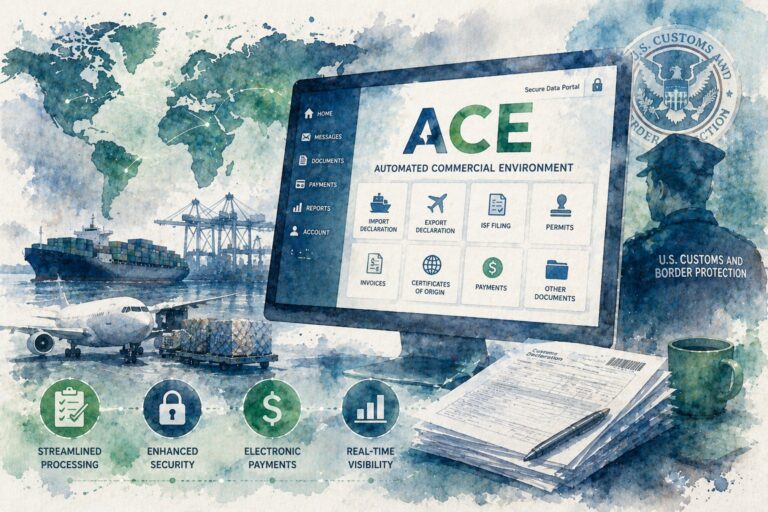
    The Automated Commercial Environment (ACE) is a processing system for commercial trade implemented by the US Customs and Border Protection (CBP). The system is designed to automate and speed up import/export border processing by providing CBP and its Partner Government Agencies (PGAs) with additional tools to approve or deny shipments, monitor trade, and enhance security. …

  • Twenty-Foot Equivalent Unit

    The Twenty-Foot Equivalent Unit (TEU) is a standard measurement used worldwide in supply chains. One TEU corresponds to the space (in cubic meters) occupied by one twenty-foot shipping container. For reference, the internal dimensions of one TEU container are 20 feet long, almost 8 feet high, and 8 feet wide. The TEU measurement is primarily…

  • Less Than Truckload

    A Less Than Truckload (LTL) service, also known as LTL shipping, is a trucking option for shipments that are smaller than an entire truckload. An LTL shipment is combined with other LTL shipments to fill a truck, with each shipper paying only for the space used rather than the entire truck. Compared with Full Truckload…

  • Less Than Container Load

    Less Than Container Load (LCL) is one of two ocean transport services available for shippers, the other being Full Container Load (FCL). LCL services are better for anyone who does not have enough cargo to fill an entire container, as smaller shipments can be consolidated into a single container, with each shipper paying only for…

  • Importer of Record

    The Importer of Record (IOR) is the person responsible for handling all supporting Customs documentation and payments on an import into the US.  This person is responsible for ensuring that all imported cargo meets all legal and Customs requirements. The importer of record can be the owner of the goods, but another party may also…

  • Harmonized Tariff Schedule

    The Harmonized Tariff Schedule (HTS) of the United States sets out and regulates all tariff rates and statistical categories for imported merchandise and is published by the US International Trade Commission (ITC). Based on the International Harmonized System used worldwide by members of the World Customs Organization (WCO), the HTS uses HS (Harmonized Commodity Description…

  • Port Filings 

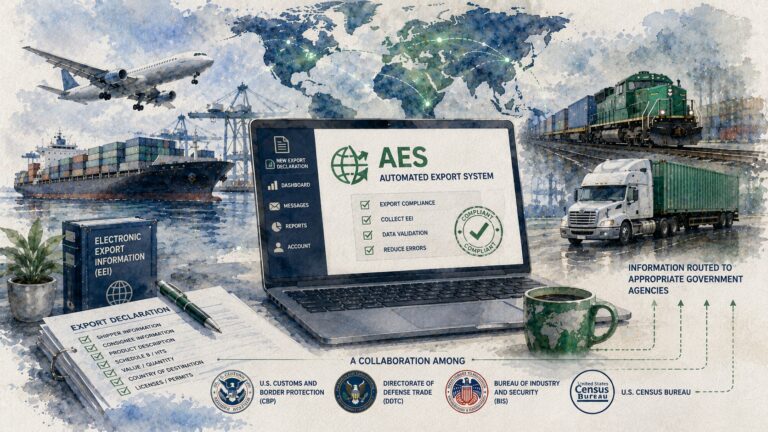
    A port filing is a message sent to the port of discharge, communicating which vessel the specific container is traveling on and the vessel’s intended destination. Port filings also include the shipment’s export declaration documents and other relevant entry documents relating to the shipment.  Port filings are a key part of the shipping process and…

  • Per Diem Charge 

    A per diem charge, also referred to as detention, is a fee applied by a carrier or container leasing company when a shipping container is returned late.  Per diem means “by the day” in Latin, and a per diem charge is a late return fee that accumulates for each day a container is not returned…